
Eggs
Hens pass antimicrobial peptides into their eggs. IMBT is interested in whether feeding insect-derived peptides could support that transfer, and in what it might mean for egg quality and value.
Home / Applications
Applications
IMBT's strongest results are in poultry. Other areas are of genuine interest but earlier. For each, we show where it stands so you can judge fit quickly.
At a glance
Filled markers show how far IMBT's own evidence has reached. They are not a prediction of future results.
Application 1
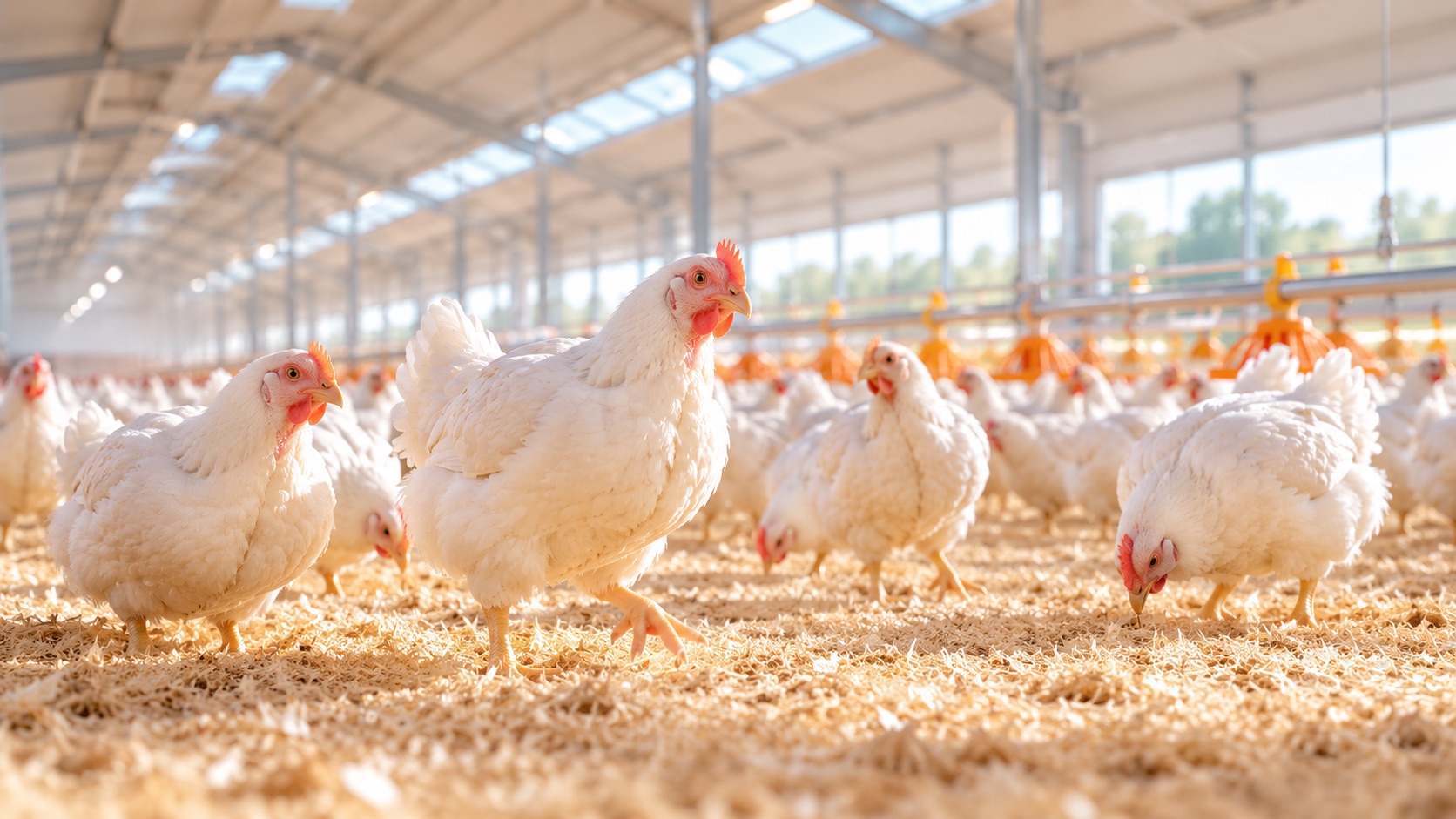
Campylobacter is carried in the gut of poultry and is a leading source of foodborne illness. In IMBT's controlled broiler study, feeding stimulated larvae led to significantly fewer colonised birds and higher expression of the chicks' own gut defence peptide.
That makes pathogen control in poultry the clearest opening for the technology, and an area where partners with flock-scale trial capability can add the most.
Demonstrated Reduced Campylobacter colonisation in broiler chicks (single study, oral challenge model).
Poultry trial facilities, veterinary and regulatory expertise, access to producers, and replication under independent conditions.
Application 2
IMBT's material is a dried, ground larval powder, and in the study it was added to commercial chick crumb at 10%. That makes feed the natural delivery route and the one demonstrated so far.
Open questions for a feed business are practical ones: inclusion rate, consistency between batches, palatability, stability in processing, supply at scale, and the regulatory status of the material in each market.
Demonstrated Effect when included in broiler feed at 10%. Potential Other inclusion rates, species and feed forms.

Feed formulation and manufacturing, quality systems, scale-up of larval production, and market and regulatory access.
Application 3
Antimicrobial peptides and innate immune regulation are active areas of research across the pharmaceutical industry. IMBT's method yields a natural, full-length peptide mixture whose profile can be shaped by exposure dose, which may interest teams studying peptides as a source or as a research tool.
This is an exploratory area. IMBT is not developing a human therapeutic, and makes no human-health claims.
Potential Interest in the peptide mixture as a research resource and in related immune-regulation questions. Research position IMBT's reasoning about natural peptide arrays versus single synthetic candidates.
Peptide characterisation and screening capability, disease-model expertise, and the appetite to explore a novel peptide source.
Application 4
The most immediate opportunity is shared research. Universities and institutes can replicate the poultry result, test other species and pathogens, characterise the peptides, and help bring the findings into the peer-reviewed literature.
IMBT offers founder access, defined material for evaluation and an open conversation about how results and rights will be handled.
Beyond poultry
IMBT's interest extends to other livestock, aquaculture and companion animals. The data we have is in broiler chickens. Results should not be assumed to carry over to other species without further study.
Potential Interest only. No IMBT data currently supports claims in these species.
Research directions
These are interests, not results. None has been tested by IMBT.
Hens pass antimicrobial peptides into their eggs. IMBT is interested in whether feeding insect-derived peptides could support that transfer, and in what it might mean for egg quality and value.
Worms and insects as part of soil health, carbon sequestration and the in-situ regeneration of animal waste. IMBT's idea is that earthworms release antimicrobial peptides in their mucus around plant roots, where they may support plant health. IMBT would like to discuss projects with research and funding partners.
IMBT is interested in how immune regulation, including IL-10 signalling, changes with age and in chronic inflammation. There are no human data, and no claim is made.
Common questions
Animal health and feed, specifically broiler chickens and Campylobacter, where a controlled study showed reduced colonisation and increased gut peptide expression.
No. IMBT makes no human-health claims. Pharmaceutical and therapeutic research is an area of interest and potential collaboration, not a demonstrated application.
Other species are of interest, but the demonstrated results are in broiler chickens. Further studies are needed.
Replication, dose and duration studies, characterisation of the peptide profile, and safety and regulatory work appropriate to each use. These are the areas where partners add the most value.
Find your fit
See an application worth exploring? Tell us what you are working on.