
Home / Technology
Technology
How IMBT turns an insect's defences into a research platform.
Insects defend themselves with antimicrobial peptides, small proteins made within hours of meeting bacteria. IMBT has developed and patented a way to trigger, shape and harvest that response, and has studied what happens when the result is fed to another animal.
Part 1 · The starting point
Insects rely on innate immunity.
Mammals have two layers of defence: a fast, general innate response, and a slower, targeted adaptive response that builds antibodies over days. Insects rely almost entirely on the first.
When an insect detects bacteria, its cells switch on genes that make antimicrobial peptides (AMPs). Hans Boman and colleagues first described this in 1981 in the cecropia moth, and the mechanism has been studied ever since. Many of the signalling pathways involved are conserved between insects and mammals.
IMBT's question is a practical one: if that response can be triggered on purpose, can the peptides be put to use?
Schematic, general immunology. Not IMBT data.
Part 1 · The IMBT method
Stimulate. Amplify. Protect.
The process is described in IMBT's granted US patent. This is the sequence in plain English.
-
1 · Rear
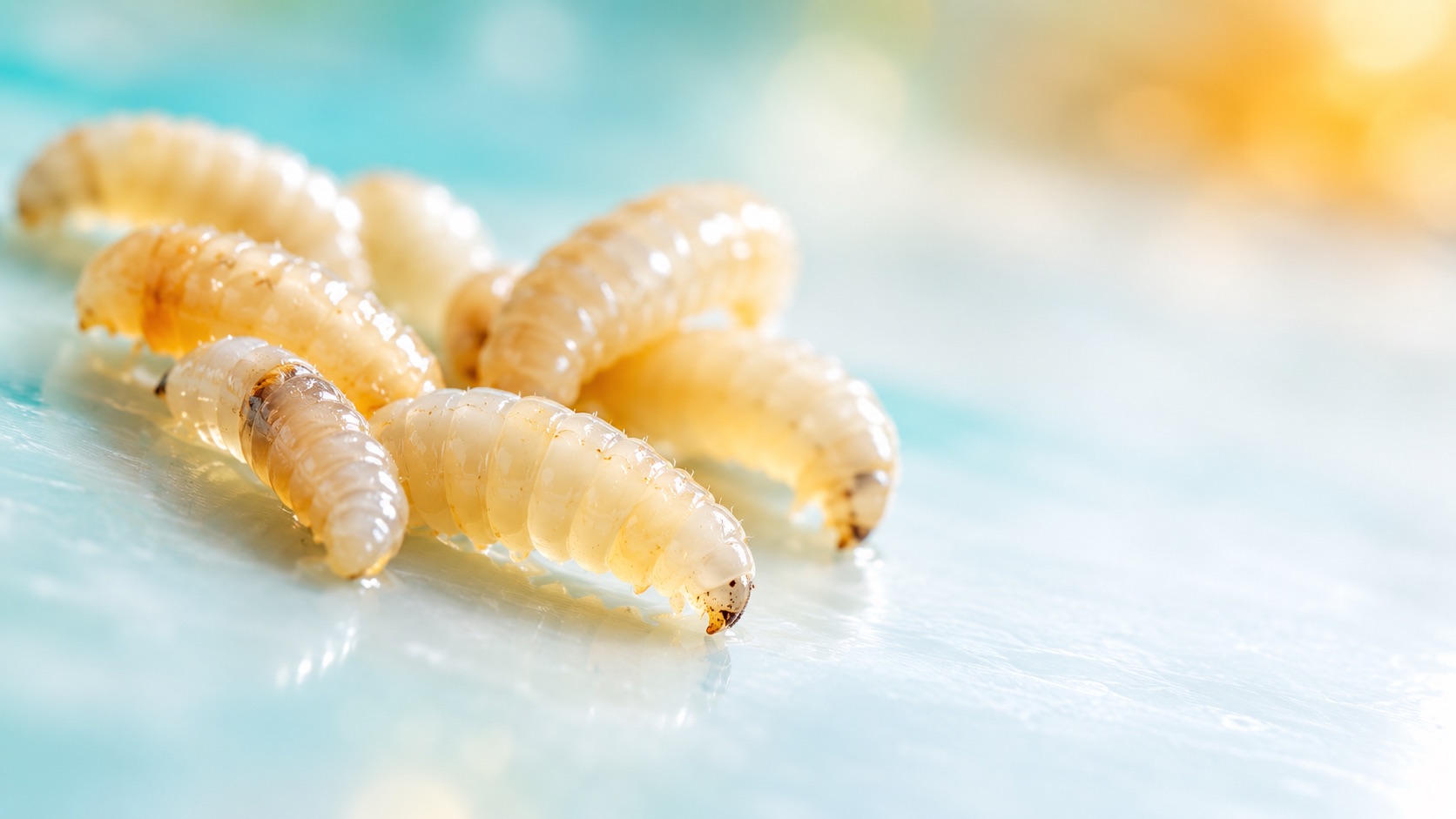
Fly larvae of the species Lucilia sericata are reared on a controlled diet.
-
2 · Stimulate
The larvae are exposed to a chosen bacterium, preferably Pseudomonas syringae. In the patent's optimal case this is four-day-old larvae for twelve hours.
-
3 · Amplify
The larvae respond by making more antimicrobial peptides, up to thirty-fold in the patent's results. The bacterial dose influences which peptides are made.
-
4 · Harvest
The larvae are washed, freeze-dried and ground into a powder.
-
5 · Protect
Added to feed, the powder was studied in broiler chicks challenged with Campylobacter jejuni, where colonisation fell and the chicks' own gut peptide expression rose.
Demonstrated Steps 1–5 are as described and tested in IMBT's patent. The poultry result is a single study and is not a clinical outcome.
What makes the method distinctive
The dose shapes the peptide mix.
Insects make a family of different peptides, each with its own activity. IMBT found that different bacterial doses favour different peptides: the patent reports that diptericin expression is favoured by high doses and sapecin by low doses.
That means the exposure can be tuned to steer the profile of what the larvae produce. It is the core idea behind the patent's first claim, and it is what separates IMBT's approach from simply feeding insects.
Drag the slider to see the idea.
Illustration of the principle only. The patent reports the direction of the effect; these bars are not measured values.
What happens next
Two effects in the poultry study.
In a study carried out under Dr Tristan Cogan at the University of Bristol Veterinary School, broiler chicks were fed stimulated larvae and then challenged with Campylobacter. The study measured two things.
The material was directly active.
In the laboratory, powder from stimulated larvae killed C. jejuni over three hours, while powder from unstimulated larvae did not.
The chicks' own defences rose.
Expression of Gallinacin 11, a chicken gut defence peptide, was higher in birds fed stimulated larvae than in birds fed unstimulated larvae.
Taken together, the authors' interpretation is that the diet supplies insect peptides directly and also prompts the bird's own peptide response. That interpretation is IMBT's research position, and it is being investigated further.
Research position Antibodies take time to appear, around 12 days by IMBT's reckoning, and a broiler chicken lives for only about six weeks. Innate defences such as antimicrobial peptides act within hours. IMBT's hypothesis is that supplying peptide-rich feed from soon after hatching could support a chick's defences during that early window. This has not yet been tested directly.
Part 2 · Immune regulation
A second effect: lower IL-10 in the poultry study.
Interleukin-10 (IL-10) is a signalling molecule the body uses as a brake. Once an infection is being dealt with, IL-10 dampens the immune response so that it does not go into overdrive. Timing matters.
Research position IMBT's view is that if IL-10 is made too early in an infection, it can reduce the production of defence peptides and give a pathogen a foothold. Some pathogens are known to exploit IL-10: Epstein-Barr virus, for example, carries a gene for its own IL-10-like protein.
Demonstrated In the same chick study, IL-10 expression in the gut-associated tissue of birds fed stimulated larvae was significantly lower than in birds fed the soya control. Two other immune signals, IL-1β and IL-6, did not differ significantly between groups.
Gene expression in one tissue, in young chicks, after a Campylobacter challenge, in a single study. The patent itself says the lower IL-10 may reflect less overall immune activation. It does not show why IL-10 was lower, or that this is beneficial.
Approximate values read from the patent's figure, which uses a log scale. The significant difference reported is stimulated larvae against the soya control.
Patented A US patent granted in 2025 covers controlling IL-10 in an animal by feeding it larvae stimulated with a micro-organism, and measuring the IL-10.
Research position IMBT's approach is aimed at rebalancing IL-10 rather than removing it, because the body needs it. Whether feeding stimulated larvae can do this in a useful way is a hypothesis being investigated, not an established result.
Research position IMBT's wider idea is that when antimicrobial peptides bind and kill a pathogen, the resulting pathogen-and-peptide complexes attract T-cells, helping the body make specific antibodies: in effect a natural form of vaccination. If IL-10 rises too early and suppresses the peptides, that link may fail. Conventional vaccines are a man-made answer to a similar problem. This is IMBT's hypothesis and is not shown by the poultry data.
In plain terms
What we are and aren't saying.
What has been shown
- Bacterial exposure raised larval peptide expression up to thirty-fold.
- Peptide profile depends on dose.
- Powder from stimulated larvae was active against C. jejuni in vitro.
- In one chick study, fewer birds were colonised and gut peptide expression rose.
What we are not claiming
- That this replaces antibiotics.
- Any effect on human disease.
- That results in chicks will carry over to other species without further study.
- That every application on this site has been demonstrated. Potential uses are labelled as such.
IMBT's research position
Why a full natural mix may matter.
Research position
Much of the AMP field focuses on single, shortened synthetic peptides developed as individual drug candidates. IMBT's position is that insects produce a wide natural mixture of full-length peptides that act together, and that this diversity may offer advantages worth investigating.
IMBT also takes an interest in how pathogens can suppress a host's own defences to avoid detection, and in how supplying peptides might support immune regulation. Part 2 above sets out the IL-10 finding so far. The wider ideas remain active areas of research for the company, not established results.
For scientists: further reading
IMBT's technical background notes discuss peptide mechanisms (membrane disruption and effects on intracellular targets), interplay with innate and adaptive pathways, and comparisons with synthetic, recombinant and fungal peptide approaches. These are presented as the company's scientific rationale and are available on request.
Common questions
Technology FAQ.
What are antimicrobial peptides (AMPs)?
Small proteins made by almost all living things as part of their innate immune defence. In insects they are produced within hours of detecting bacteria.
Why does IMBT use insect larvae?
Insects rely on innate immunity and respond to bacterial exposure by making AMPs. Larvae allow that response to be triggered, controlled and harvested efficiently. In IMBT's patented method, exposure raised peptide expression up to thirty-fold.
Is this an antibiotic?
No. IMBT's approach is investigated as a way of supporting an animal's own defences using peptide-rich material from stimulated larvae. It is not presented as a replacement for antibiotics.
What is IL-10?
Interleukin-10 is a signalling molecule (a cytokine) that the body uses to calm an immune response once an infection is under control. In IMBT's poultry study, birds fed stimulated larvae showed lower IL-10 expression than birds fed soya. What this means is still being investigated.
Is the technology proven?
Specific results have been demonstrated, including higher larval peptide expression and reduced Campylobacter colonisation in a broiler chick study. Wider applications remain potential and are being explored.
Is the method protected?
Yes. IMBT holds protected intellectual property covering the method. Details are shared with serious enquirers.
Next step
Interested in the science or the method? Chris Leonard works directly with research and commercial partners.